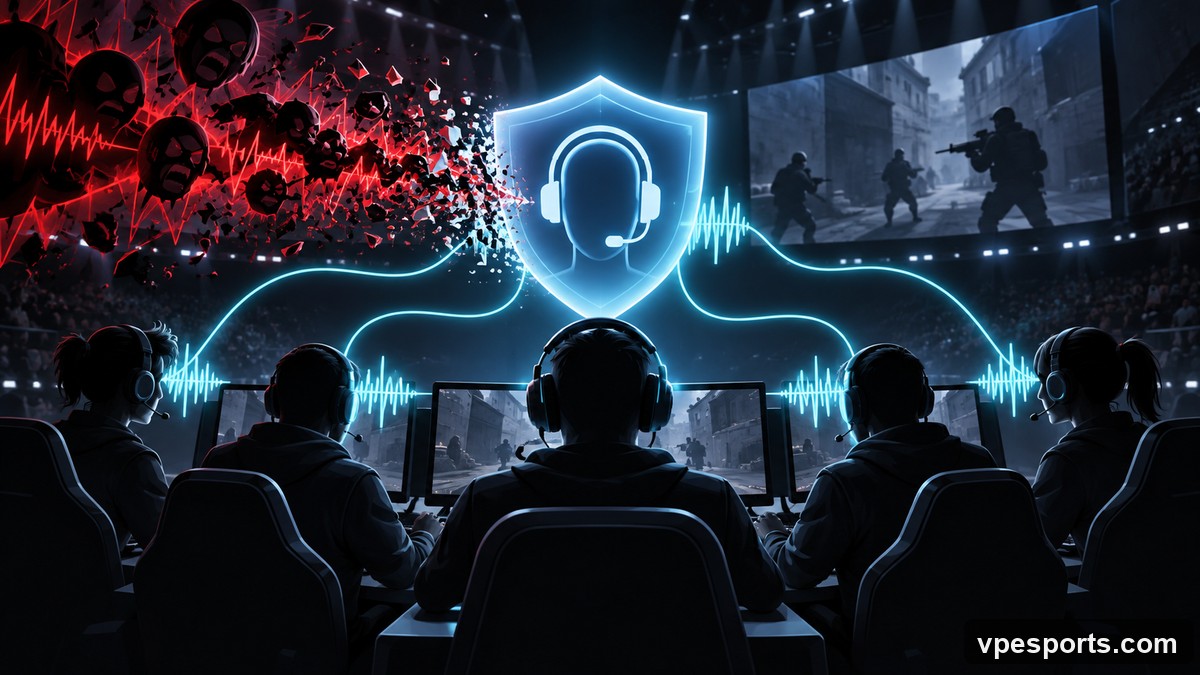
Riot has expanded VALORANT’s voice abuse detection in Patch 13.06 and published a clearer explanation of how players should use comms and reports. Riot Voice Evaluation now has improved support for Spanish, Portuguese and Korean, with additional languages planned for the coming months. The company says broader improvements helped it identify and penalize twice as many instances of voice abuse over the last year. The announcement does not say that every heated comment is prohibited or that every report automatically produces a sanction.
The update is aimed at conduct that interferes with the competitive purpose of communication. VALORANT relies on voice for enemy locations, utility timing and retake plans, but the same channel can carry harassment, threats, hate speech or repeated personal attacks. Riot’s position is that these forms of abuse are not an unavoidable part of tactical competition. Better detection is intended to make useful calls easier to maintain, not to require constant positivity from every teammate.
Language coverage is a practical part of that goal. A system that evaluates only a narrow group of speakers cannot apply the same standard across a global player base. Riot specifically names Spanish, Portuguese and Korean in the Patch 13.06 expansion and says more languages will follow. That wording confirms a broader rollout is planned, but it does not identify those future languages or give a date for each one. Any such list would go beyond the announcement.

Where Riot draws the line on voice comms
Riot is not trying to remove all trash talk. Its suggested boundary is to keep comments about the game rather than the person. Questioning a play or trading competitive banter can remain part of a match. Repeatedly targeting another player, attacking identity, making threats, or using hate speech and slurs crosses the stated line. Context still matters, which is why the announcement describes evaluation rather than a simple forbidden-word counter.
Player reaction can also be an immediate warning. If teammates object, stop communicating, or repeatedly report the same behavior, Riot advises the speaker to pull back and return attention to the match. That is not a formula proving guilt, and the post does not say a certain number of reports guarantees punishment. It is practical guidance for recognizing when banter has stopped functioning as part of competition and has become disruptive to the people sharing the channel.
The same rules apply when a player believes they are defending themselves. Riot says a targeted player may stand up for themselves, but the initial abuse does not give anyone permission to answer with hate speech or other prohibited conduct. Both sides can face action if both cross the line. Muting, disengaging and reporting are therefore safer responses than extending an argument through the rest of the match.
This policy update should not be merged with Riot’s anti-boosting program. Boosting and win manipulation concern competitive integrity and account behavior. Riot Voice Evaluation concerns abusive communication. Both sit under the company’s broader community standards, but they use different evidence and address different harm. Treating the new language support as another smurfing measure would misstate what Patch 13.06 changed.
Why an accurate report still matters
Riot asks players who encounter abusive voice chat to choose the Voice Comms Abuse category in the in-game report tool. Reports flag interactions for evaluation and provide data that can improve the detection system. The company presents player reports and automated evaluation as connected parts of enforcement, not substitutes for one another. A report is useful information; it is not a public verdict and should not be described as an automatic ban request.
The reported increase in detected and penalized cases shows scale rather than perfection. Riot says its improvements produced twice as many actions against voice abuse over the last year. That comparison does not reveal how many incidents remain undetected, nor does it prove that toxicity has doubled. It shows that the system is finding and acting on more cases under Riot’s process.
For ordinary players, the guidance is deliberately simple. Keep calls and banter attached to the game, avoid turning frustration into personal abuse, and report voice incidents through the category designed for them. If another person begins the abuse, responding in kind can create a second policy violation rather than erase the first. The language expansion makes evaluation available to more conversations while leaving the behavioral standard unchanged.
Patch 13.06 expands Riot Voice Evaluation to better handle Spanish, Portuguese and Korean while Riot prepares support for more languages. The accompanying guidance protects competitive banter but rejects threats, hate speech and repeated personal attacks. Reports remain an important input, and players are expected to keep their own responses within the rules even when someone else starts the conflict.