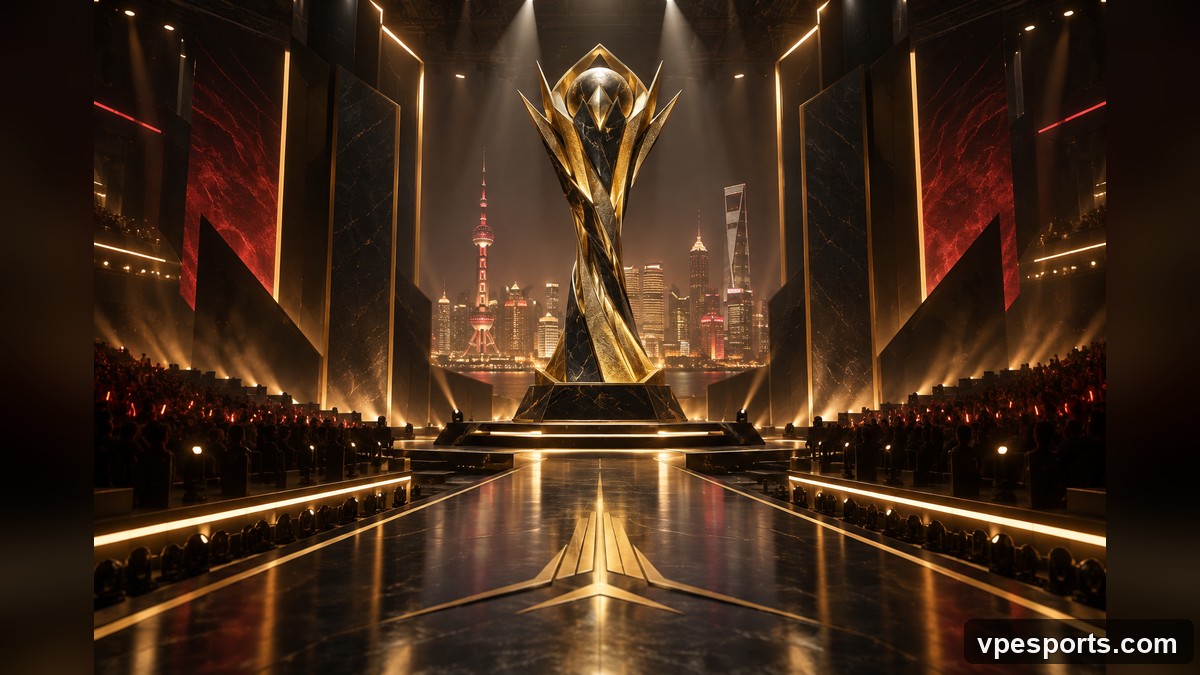
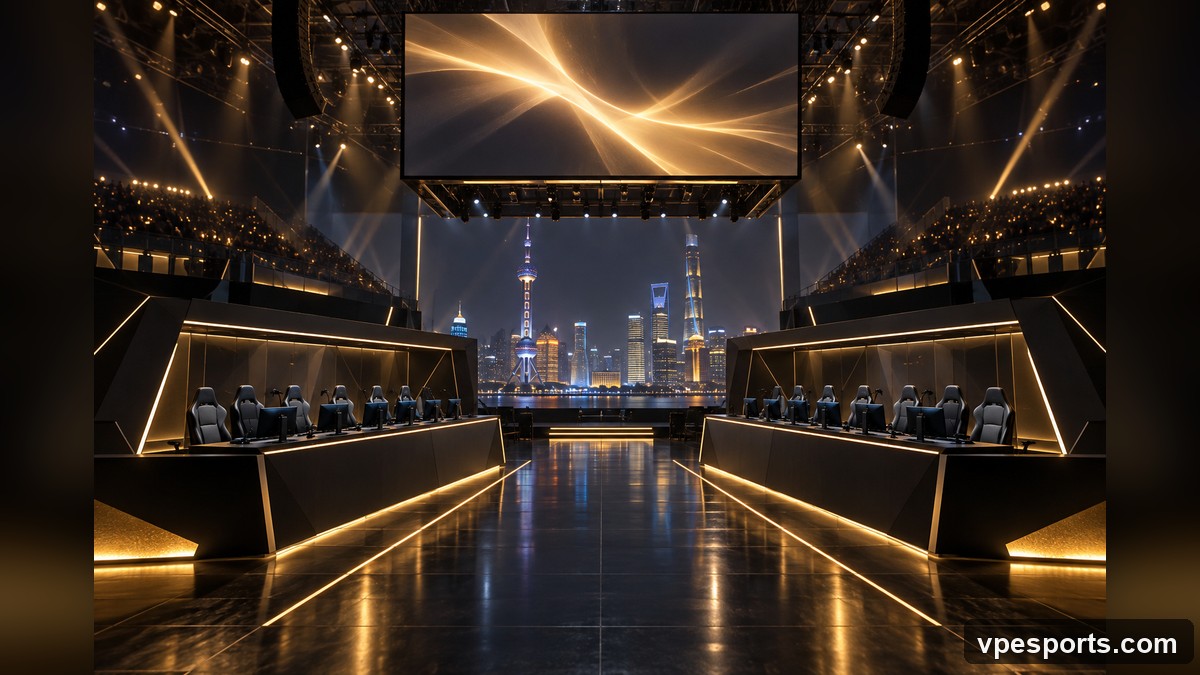
Opening-day images from VALORANT Champions 2026 have revealed the trophy and the tournament’s first stage inside Shanghai’s Jing’an Sports Center. The setup places the two team areas opposite each other across a central aisle, with a large screen suspended above a black-and-gold arena design. The trophy uses a gold cup on a dark base with silver elements around its upper and lower sections. It remains unawarded while 16 teams compete through October 18.
The stage is arranged to keep the competitors visually separated while preserving one direct line through the center of the room. Each team plays from an area on the opposite side of the aisle. The overhead screen gives the audience a central display above that axis rather than placing the main visual focus behind only one roster.
Black and gold carry across the group-stage design and connect the venue to the trophy placed at the center of the event’s identity. The available images establish the layout and colors, but they do not change the competitive format. Matches remain best-of-three during groups, and a team still needs results inside its GSL bracket to move forward.
The trophy itself is built around a golden cup resting on a dark base. Silver forms wrap its upper and lower sections, creating contrast without replacing the gold center. It is the object the final winner will receive, not an award already assigned after the opening day.
Jing’an hosts the tournament’s first phase
Champions Shanghai began on September 24 with 16 teams divided into four groups. Each group contains four teams and follows the GSL structure. Two victories qualify a team for playoffs, while two losses eliminate it. The top two from each group create an eight-team playoff field.
Jing’an Sports Center hosts the group stage and the initial playoff matches. That makes the revealed setup more than a temporary opening ceremony backdrop: it is the competitive environment for the entire first stage and part of the elimination bracket. The report does not say that every match through the final remains there.
Playoffs begin on October 7 and use double elimination. Most series remain best-of-three, with the lower final and grand final expanding to best-of-five. The venue sequence therefore follows the competitive narrowing of the event, moving from 16 teams in groups toward the final contenders.
The tournament later transfers to Mercedes-Benz Arena for the concluding show, including the grand final on October 18. The move gives the final a different physical setting from the one shown in the group-stage reveal. Viewers should not assume that photographs of the Jing’an setup represent the exact layout that will appear on the last day.
The official schedule separates groups, dark days, playoffs and finals across a run ending on October 18. That extended calendar explains why the event can use more than one venue without changing cities. Shanghai remains the host throughout, while the arena changes as the field and production scale move toward the title match.
No competitive advantage can be inferred from the stage design. Opposite team areas, the central aisle and the overhead screen describe the presentation. Match outcomes still depend on the game, and the cited reports do not attribute a technical or crowd-related benefit to either side.
The reveal establishes the event’s visual identity
A world championship trophy needs to remain recognizable across stage shots, broadcast graphics and the final ceremony. The gold cup, dark base and silver wrapping give this edition a distinct material profile. The black-and-gold room echoes that palette without requiring the trophy to dominate every camera angle.
The central aisle also creates a direct route between the competing areas and the trophy presentation space. On opening day, that geometry supports the story of multiple teams entering from opposite sides of the bracket toward one award. It is a presentation choice rather than a new tournament rule.
The most important limitation is timing. Showing the trophy does not identify its future owner, and the first venue does not decide who reaches the second. Group play must reduce the field from 16 to eight, after which the double-elimination bracket determines the finalists. The trophy reveal starts that visual narrative while the competitive result remains entirely open.
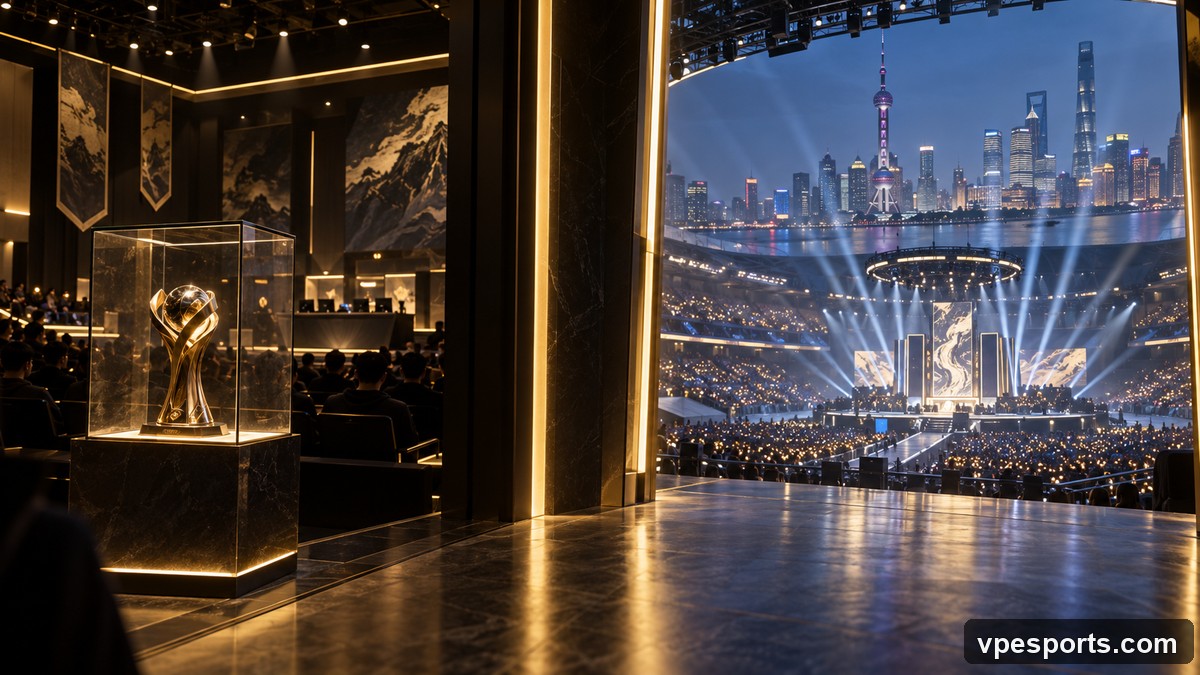
Champions Shanghai has paired a gold, silver and dark-base trophy with a black-and-gold opening venue at Jing’an Sports Center. The setup will carry the group stage and early playoff matches before the tournament shifts to Mercedes-Benz Arena for the October 18 final. The images define the event’s look, while the winner remains to be decided across the full bracket.